
Cell counting is a key step in many experiments. It can provide the final result of an analysis or be a source of data necessary for further proceedings. Which cell counting method to use depends on many factors. It is worth learning the fundamentals and the advantages and disadvantages of each method in order to choose the one that is right for your laboratory’s needs.
For what purpose are cells counted?
Before starting the culture, it is necessary to know the exact number of cells in the culture vessels. This is important for the success of the experiment, as concentration is one of the key aspects determining optimal culture growth. In addition, the value of this result serves as a reference point for the final result.
Monitoring cell numbers during culture at various stages allows the impact of different factors on growth and proliferation to be determined. It also makes it possible to determine the degree of confluence, which is necessary, among other things, before performing a passage.
Many analyses require precise knowledge of the number of cells and their constant number. These include, for example, transfection or quantitative PCR.
Manual methods of cell counting. Counting in a haemocytometer chamber
This is the oldest method of counting cells. It requires a light microscope and a slide with a precise grid, i.e. a chamber of a specific volume. Special dyes are often used to highlight specific cells.
Among the most popular haemocytometers are: the Bürker chamber, the Thom chamber and the Fuchs-Rosenthal chamber. Their principle of operation and design are very similar. They are polished base slides with centrally placed grid lines for counting, separated by a system of grooves.
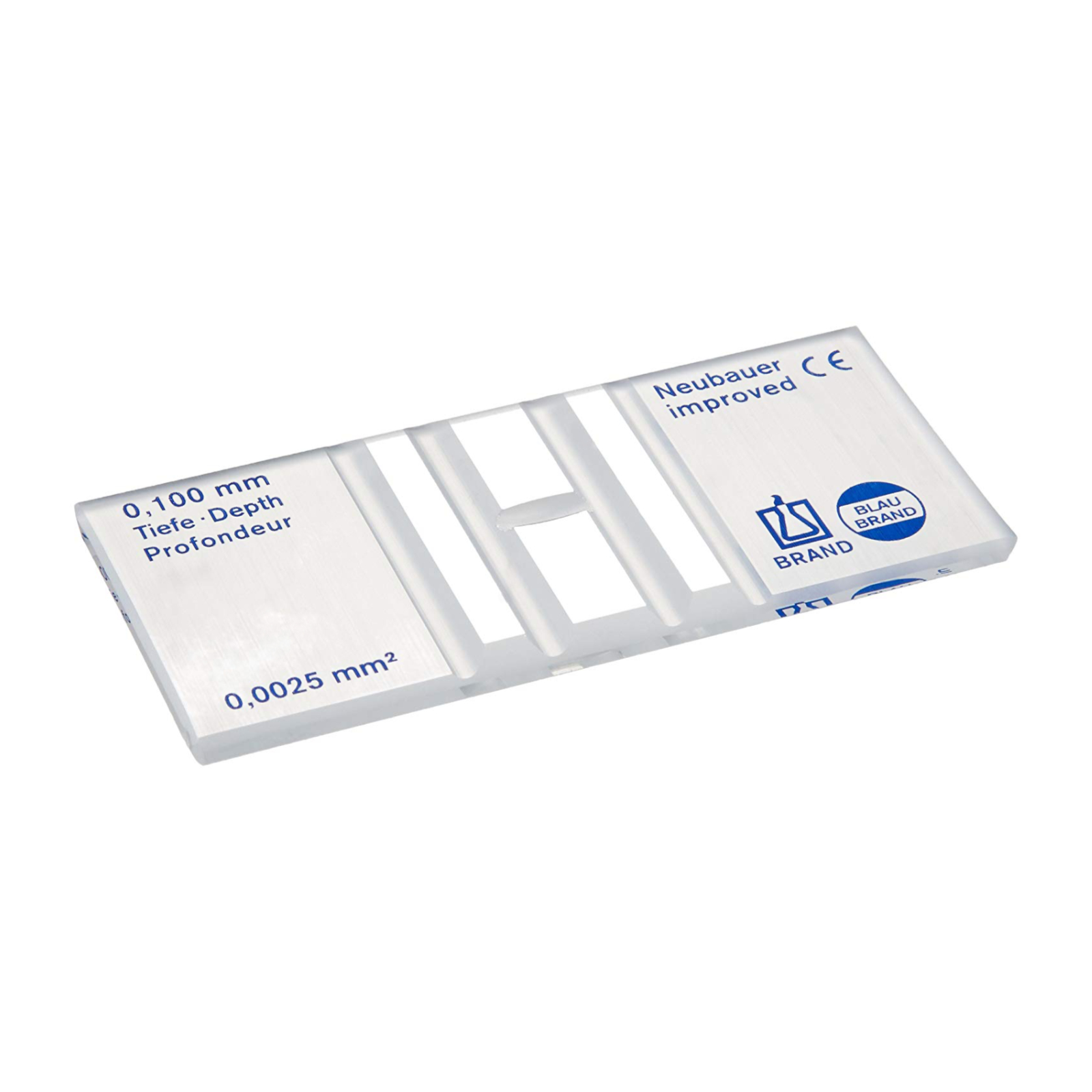

To perform the measurement, place a cover glass and then carefully apply a precisely defined volume of cell suspension to its edge. Due to the fact that the grid grooves are wider than the cover glass, the cell suspension passes under the cover glass thanks to surface tension.
The grid fields have a known area and the cells are counted in a certain number of these fields. This provides the statistical sample needed to calculate the concentration of cells in the culture.
The method is relatively inexpensive. The chamber can be used multiple times. However, counting takes a long time and it is not possible to obtain a substantial statistical sample in a short period of time. In addition, cells may die in the chamber during counting, which distorts the result. The method is also subject to operator error – eye strain, experience, subjective feelings.
Automatic cell counting methods
Image analysis, flow cytometry or electrical impedance are the basic methods on which the principles of the best-known automated cell counters are based.
Flow cytometry
Flow cytometry utilises the phenomenon of light scattering. Fluorescently labelled cells flow in a thin stream through the cytometer. In the measurement zone, each cell is illuminated by a laser beam. The laser light is scattered and at the same time the fluorochromes present on the cell surface are excited. This is recorded by a detector, which allows not only the cells to be counted, but also differentiated. Furthermore, a flow cytometer can be used to sort cells. It is a fast and accurate method, but it requires a large financial investment.
Cell counters based on image analysis
This type of automatic counter uses the action of a light or fluorescence microscope and a camera.
A sample is placed on a slide, in a cassette or in a feeder containing tubes with cell suspensions and control samples. The sophistication of these devices varies greatly depending on the manufacturer. The principle of operation is based on taking microscopic images and automatically counting cells. Depending on the application, the material may be stained accordingly. These devices have a built-in computer or can be connected to an external computer.
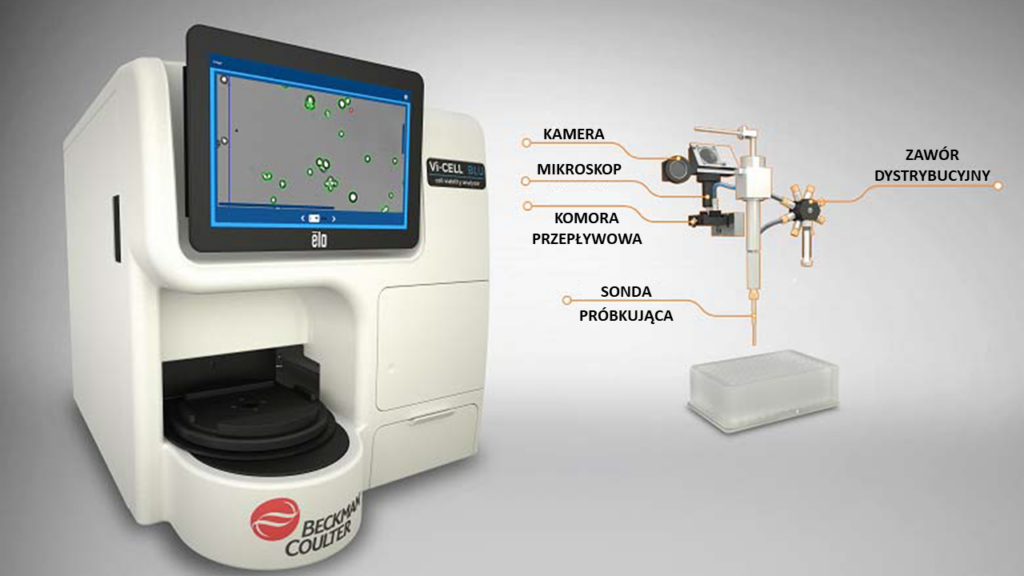
Automatic image analyzer. Source: https://www.itsscience.pl/
Coulter counters
Their principle of action is based on the phenomenon of changes in electrical resistance under the influence of particle flow in an electrolyte solution. This allows for the detection and differentiation of cells.
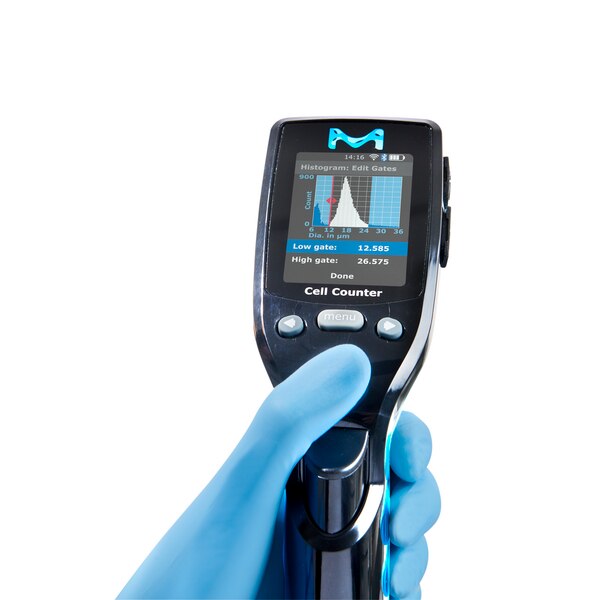
As with image-based counters, a sample of cell suspension is required. The appearance and sophistication of these devices varies greatly: from large equipment with a built-in computer to analysers the size of an automatic pipette. The latter allow measurements to be taken in less than a minute. To take a measurement, a disposable sensor resembling that of an automatic pipette is attached and the contents of the test tube are aspirated. The cells in the suspension flowing through it are counted by the device and the result is displayed on a small built-in screen. The data can be analysed after being downloaded to a computer.
Automatic coulter counter. Source: https://www.merckmillipore.com/
Which method of cell counting to use?
The choice of cell counting method depends on many factors. First of all, the needs of the laboratory are important. In the case of large-scale cultures, haemocytometers are unlikely to be suitable, as counting can take a very long time in this case. Automatic analysers offer much greater possibilities. They are seen as the solution for the future. However, it should be noted that it is difficult to imagine the development of cell culture methodology without manual counting chambers. They require more attention and experience than automatic analysers, but they can be used successfully, especially in smaller-scale cultures. If we want a quick analysis or to use the counter directly in a laminar flow cabinet, it is worth considering a compact pipette counter. A flow cytometer will provide accurate results along with sorting. A lot also depends on funding, as the price variation, depending on the method, is enormous.