
In the world of modern analytical chemistry, dominated by affinity interactions, ion exchange and reversed phases, size exclusion chromatography (SEC) occupies a special place. It is the only technique in which the success of separation depends not on a chemical battle for binding sites, but on the physical interaction of molecules with the spatial architecture of the resin pores.
Definition and terminology: SEC, GPC, or GFC?
Mass exclusion chromatography is a separation technique in which molecules in a solution are separated according to their hydrodynamic volume (often correlated with molecular weight). Depending on the type of mobile phase and the nature of the sample, interchangeable nomenclature is used:
- GPC (Gel Permeation Chromatography): A term used when the mobile phase is an organic solvent (e.g. THF, DMF), most commonly in the analysis of synthetic polymers.
- GFC (Gel Filtration Chromatography): A term used in the case of aqueous phases, typical for the separation of biopolymers (proteins, nucleic acids).
- SEC (Sized Exclusion Chromatography): A universal term covering both of the above subcategories.
Separation mechanism in size exclusion chromatography (SEC)
Unlike most chromatographic techniques, in SEC the largest molecules elute first. This mechanism is based on the differentiation of the available pore volume for molecules of different sizes.
Theory of diffusion into pores
The resin in the SEC column consists of porous spherical particles with a strictly defined pore diameter.
- Particles above the exclusion limit: These are too large to penetrate the pores. They only move in the space between the resin particles and leave the column the fastest.
- Medium-sized particles: These can penetrate part of the pores. Their path is elongated, which delays their elution.
- Small molecules: They have access to almost the entire pore volume (total penetration volume). They elute at the very end.
The basic equation describing retention in SEC is:
Where:
- Ve – retention (elution) volume,
- V0 – dead volume (free space between grains in the bed),
- Vp – volume of pores within the deposit,
- Ksec – distribution coefficient (for ideal distribution, it takes values from 0 to 1).
How to develop the SEC method?
Pore size
The development of the SEC method should begin with the selection of the column. This is critical. Currently, traditional beds based on soft dextran gels (e.g. Sephadex) have given way to modern rigid materials that allow for high-pressure operation (UPLC/UHPLC).
One of the most important values to pay attention to is the pore size in the column. It is expressed in Angstroms (Å). This value determines how large molecules will penetrate into the pores. In short, the pore size determines the range of masses on which the column can act.
| Pores size [Å] | Range of operations (MW) [kDa] | Typical applications / Analytes |
| 40 – 60 | 0.1 – 10 | Small peptides, oligonucleotides, low molecular weight pharmaceuticals. |
| 125 | 1 – 80 | Small globular proteins, peptides with a complex structure. |
| 200 | 5 – 300 | Most plasma proteins, enzymes, antibody fragments (Fab, scFv). |
| 300 | 10 – 1000 | Standard for monoclonal antibodies (mAbs), protein dimers and oligomers. |
| 450 – 500 | 20 – 2000 | Large protein complexes, high-molecular aggregates, vaccines. |
| 1000+ | 100 – 10 000 | Viruses, virus-like particles (VLPs), large synthetic polymers. |
Types of stationary phases in size exclusion chromatography (SEC)
Currently, there is a wide selection of columns for size exclusion chromatography (SEC). Dextran (Sephadex), silica gel, and polymer (PS/DVB) columns are available. Here is how to choose the right one for your application.
Dextran resins
Dextran resins (Sephadex, Sepharose) are natural carbohydrates. They form a soft mesh that acts as a molecular sieve. They have low mechanical resistance, so they cannot be used with high pressure (HPLC, UHPLC). Dextrans are ideal for preparative protein chromatography (e.g. in FPLC).
Diol Groups
Silica gel is often subjected to chemical modifications. Silica is often modified with molecules containing acid groups on adjacent carbon atoms (the so-called diol bond phase). These have a dual effect. Firstly, they form a water coat on the surface of silica, which prevents molecules from interacting with the stationary phase. Secondly, they mask Si-OH groups that could interact ionically with positively charged amino acids. These fillings are ideal for protein separation.
Polystyrene – divinylbenzene (PS/DVB)
This phase is most commonly used in the separation of polymers. It is not a modification of silica, but rather a polymer used as a stationary phase. The advantage of this solution is its high resistance. The PS/DVB phase is used in the separation of polystyrenes, polyethylene and polypropylene. Separation takes place in a mobile organic phase such as THF or toluene.
Hydroxyl groups on polymethacrylate matrices
These resins are used in sections where there is a suspicion that the analytes could irreversibly bind to silica, or where a very high pH is required (silica dissolves at pH above 9). Methacrylate polymers are resistant to high pH (12–13). Thanks to the presence of -OH hydroxyl groups, they are ideal for separating natural water-soluble polymers such as starch or cellulose.
Hybrid technology, e.g. BEH
The introduction of hybrid particles was a breakthrough in SEC. Instead of pure silica, which is susceptible to chemical degradation and has active acid groups, ethylene bridges connecting silicon atoms were used. Hybrid columns have properties characteristic of both silica and polymers.
Advantages of BEH in SEC:
- Mechanical stability: Possibility of using very small grains (1.7 μm), which drastically reduces analysis time and increases resolution.
- Minimal secondary effects: BEH particles are more chemically inert than traditional silica.
- Durability: High resistance to pH and pressure.
BEH columns are ideal for analysing protein aggregates.
Choosing a stationary phase – summary
The choice of bed is primarily determined by the type of analytes to be separated. The table below summarises the most important properties of various beds used in mass exclusion chromatography.
| Resin type | The main “chemistry” of the surface | Working environment | Main area of application |
| Modified Silica | Diol groups | water/salt | Proteins, peptides (high resolution) |
| Hybrid (e.g. BEH) | Diol groups | water | UPLC, rapid mAb analysis |
| PS/DVB (Polimer) | Aromatic rings | Organic (THF, DMF) | Synthetic polymers, plastics |
| Polymethyl methacrylate | hydroxyl groups | Water (wide pH) | Polysaccharides, water-soluble polymers |
| Agaroza/dextrane | carbohydrates groups | Water (buffer) | Protein preparation, desalination, bioprocess |
Mobile phase: The art of avoiding interactions
Perfect SEC separation occurs when there are no chemical interactions between the analyte and the stationary phase. The mobile phase must therefore act as a ‘buffer’ to eliminate side effects.
Key parameters:
- Ionic strength: In GFC (protein analysis), too low ionic strength may lead to undesirable electrostatic interactions with residual silanol groups on the silica surface. Salt concentrations of 150–300 mM are typically used.
- pH: Must ensure analyte stability and minimise surface charge on the bed. For protein separation, it is desirable for the pH of the mobile phase to be close to the isoelectric point of the analytes. This will minimise protein charge and reduce possible ionic interactions with the stationary phase.
- Organic additives: Small amounts of isopropanol or acetonitrile are sometimes added to prevent hydrophobic interactions between proteins and the polymer matrix of the bed.
Applications of mass exclusion chromatography
Protein aggregation test
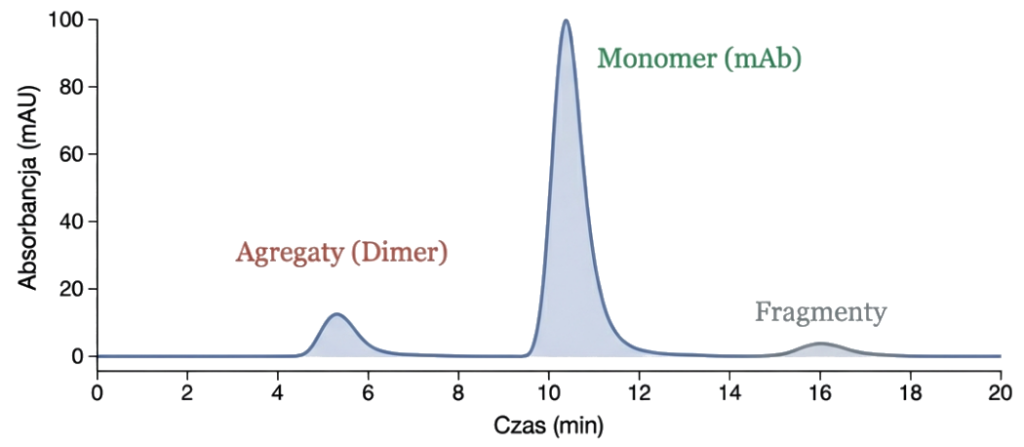
In biopharmaceuticals, SEC is the gold standard for monitoring the purity of monoclonal antibodies (mAbs). It allows for the precise separation of monomers from dimers and higher aggregates, which is crucial for the immunological safety of the drug.
Wyznaczanie mas cząsteczkowych i polidyspersji
In polymer analysis, SEC (GPC) provides information on molecular weight distribution.
- Mn (numerical average molecular weight)
- Mw (weight average molecular weight)
- PDI (Polydispersity index): The Mw/Mn ratio, which determines the homogeneity of the sample.
Practical tips for analysts
- Sample preparation: The sample must be fully soluble in the mobile phase. Filtration (0.22 µm) is mandatory to protect the expensive column.
- Pore selection: The pore size must be matched to the expected mass of the analyte. If the sample elutes at V0, the pores are too small; if at Vt, the pores are too large.
- Calibration: SEC is a relative technique. It requires calibration using standards with known mass and structure similar to the analyte. Calibration mixtures tailored to different types of analysis are available on the market.
Literature
- Goyon A., et al., Evaluation of size exclusion chromatography columns packed with sub-3μm particles for the analysis of biopharmaceutical proteins, J. Chromatogr. A, 1498 (2017), 80-89.
- Hong P., Koza S., Bouvier E.S.P., Size-Exclusion Chromatography for the Analysis of Biotherapeutics and their Aggregates, J. Liq. Chromatogr. Relat. Technol., 35 (2012), 2923-2950.