
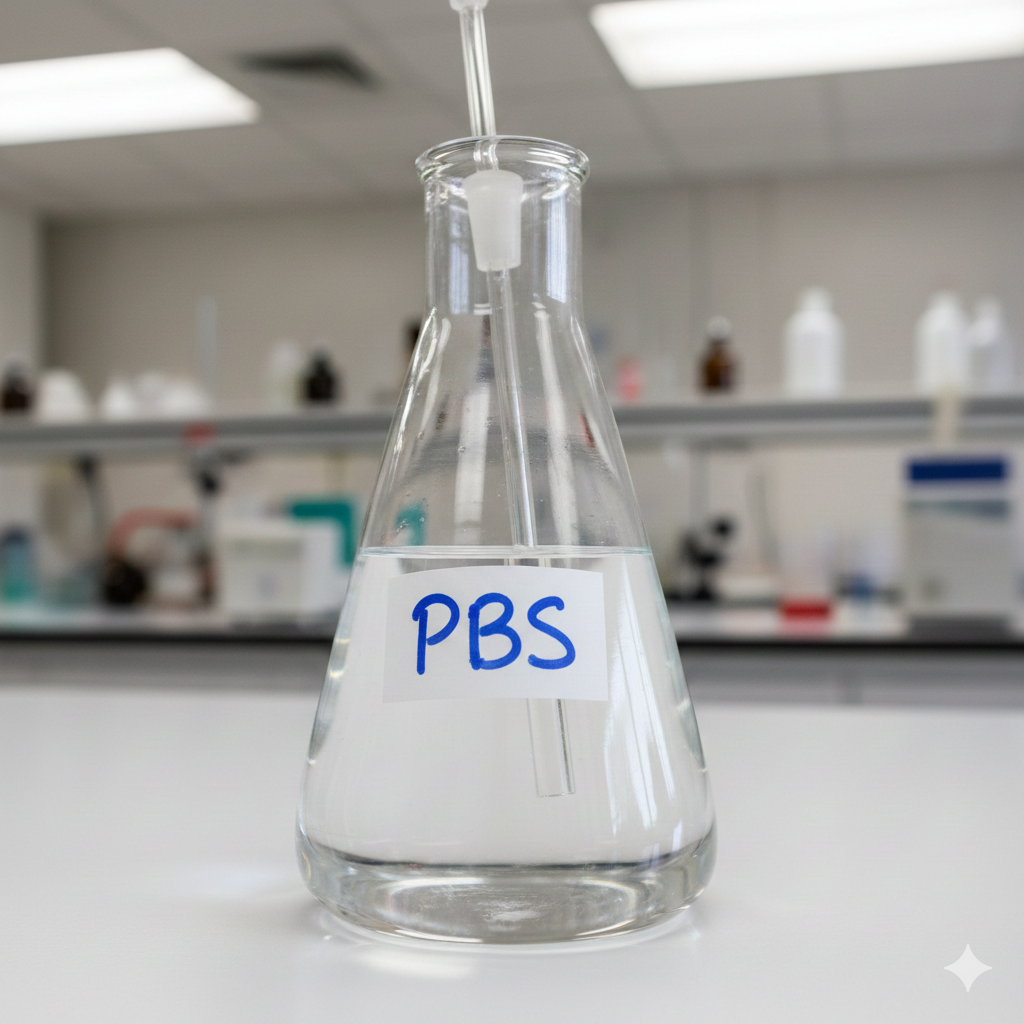
PBS (Phosphate-Buffered Saline) is one of the most commonly used solutions in biological research. It is used in enzymatic studies, cell cultures and immunometric analyses. Its composition and pH are similar to physiological conditions, which ensures optimal conditions for many laboratory applications.
Why is PBS so important?
PBS has two properties that make it so widely used. Firstly, it is isotonic, and secondly, it maintains a pH level of 7.4.
- Isotonicity: PBS is an isotonic solution. This means that the salt concentration is such that the osmotic pressure of the solution is identical to that inside cells. Thanks to this, cells do not break down during experiments. The right salt concentration is also important for the proper functioning of many enzymes, receptors and antibodies.
- pH: PBS maintains a pH of approximately 7.4. This corresponds to the pH found in tissue fluid and cytoplasm. It is therefore the value at which most biological processes occur and is optimal for many enzymes and receptors.
What does PBS consist of?
PBS consists of water and mineral salts found in saline solution: sodium chloride and potassium chloride. It has been enriched with sodium hydrogen phosphate and potassium dihydrogen phosphate. These act as buffers and maintain a constant pH of 7.4.
What can PBS be used for?
PBS has many uses. Thanks to its universal composition and good buffering properties, it can be used in the following applications.
1. In vitro Cell cultures
This is the most common application. PBS is used to wash cells in culture bottles. Before adding enzymes (such as trypsin) to detach cells from the substrate, any remaining medium that could inhibit the enzyme must be rinsed away. PBS is ideal for this purpose.
Important: PBS without calcium and magnesium ions is usually used for washing cells to prevent cell clumping.
2. Immunological techniques (ELISA, Western Blot)
In protein detection tests such as ELISA or Western Blot, PBS acts as a solvent for antibodies and a washing buffer. It helps remove unbound molecules without destroying the delicate bonds between the antigen and the antibody. In order to reduce surface tension and increase penetration capacity, a detergent such as Tween-20 or Tween-80 is often added to PBS.
3. Microbiology
It is used to prepare serial dilutions of bacteria. If we want to count bacterial colonies, we need to dilute the sample. Using water would destroy the bacteria (due to osmotic pressure), whereas PBS allows them to survive the counting process.
4. Transport of biological samples
Due to its physiological environment-preserving properties, PBS is often used as a transport medium for swabs or collected tissues before they are sent for analysis.
5. Freezing cells and bacteria
PBS, with its physiological composition and ability to maintain the correct pH, is ideal for freezing cells and bacteria. For this purpose, a cryoprotectant is usually added to the solution to reduce the size of water crystals and prevent cell damage during freezing.
How to prepare PBS?
PBS is usually prepared as a 10x concentrated solution and diluted before use.
10 x PBS
Ingredients (per 1 litre):
- 80 g NaCl
- 2 g KCl
- 17,8 Na2HPO4
- 2,4 g KH2PO4
Weigh the ingredients and transfer them quantitatively to a 1 litre volumetric flask. Add approximately 950 ml of water and dissolve the ingredients (preferably using a magnetic stirrer). Use HCl and NaOH to adjust the pH to 7.4. Fill with water to the mark and mix by swirling.
The solution prepared in this way can be stored until the experiment.
1x PBS.
Transfer 100 ml of 10x PBS to a 1-litre volumetric flask. Fill with water to a volume of approximately 950 ml and mix. Fill with water to the mark and mix again by swirling.
Please note! If you are preparing PBS for use in cell cultures or microbiology, remember to filter it through a sterilization filter.