
An inherent part of working in a laboratory is exposure to harmful agents. Organisms or biological substances , which are dangerous to the environment, humans or animals are referred to by the term “biohazard”. They are classified into four biohazard levels (BSL-1 to BSL-4).

Each level requires appropriate procedures to prevent the spread of microorganisms or biological agents. Classification is closely related to infectivity as well as the severity of the diseases caused and the ability to transmit them.
Taking into account the above factors, it is necessary to adopt appropriate levels of hermeticity of the laboratory space and apply adequate safety rules.
What is BSL-1?
Applies to well-characterized organisms that do not cause disease in healthy humans. They pose minimal risk to the safety and health of laboratory staff. These include non- pathogenic strains of Escherichia Coli, Staphylococcus, Bacillus subtilis or Saccharomyces cerevisiae.
Most work with biological agents classified as BSL-1 can be performed on open laboratory tables. Class I laminar chambers can be used due to the need for operator protection. It is not necessary to use barrier protection. Standard microbiological procedures are followed during work. Staff should wash their hands before entering and before leaving the laboratory. For this reason, employees must have access to washbasins in the laboratory area.
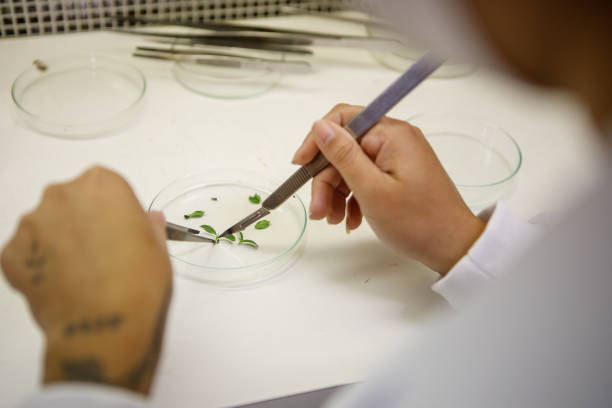
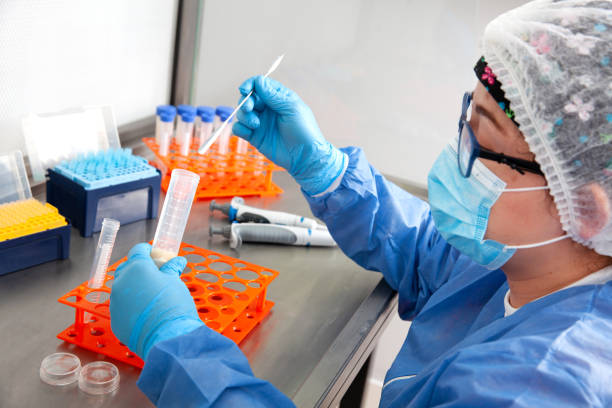
Standard personal protective equipment is used at BSL-1, but only when personnel are exposed to hazardous material. Laboratory aprons, gloves and, when the situation calls for it, protective masks and laboratory goggles are used.
The laboratory should be separated by a door that can be closed to restrict access. However, a separate area in the building is not required. It is recommended that tinting screens be used on windows to help control the effect of sunlight on the material being tested.
What is BSL-2?
Biological agents classified as BSL-2 pose a moderate risk to the environment and the operator. Examples of such organisms include HIV as well as hepatitis A, B or C viruses. They also include Plasmodium falciparum and Toxoplasma gondii. and even prions such as vCJD , which, however, are often tested in higher-grade laboratories[16].
All safety precautions from the lower BSL level are used during operation. BSL-2 differs from BSL-1 in additional safety precautions. Personnel should have training in working with pathogens. The use of protective clothing, disposable gloves is required.
Procedures that may generate aerosols or splashes should be performed in a Class II laminar chamber with forced air circulation.Such a chamber provides microbiological protection for the operator and the sample. In this case, respiratory protection in the form of a protective mask should also be used. Laboratory equipment requires regular decontamination. For this purpose, autoclave or UV light (ozonation) and also alcohol solutions for surface disinfection are used, among others.

The washbasin should be located near the exit. An eye wash station is also required. The laboratory equipment should include an autoclave. A self-closing door must lead into the room. As in BSL-1, exposure to sunlight should be limited. Tinting films for windows can be used for this purpose.
What is BSL-3?
Organisms classified as BSL-3 are potentially dangerous to human health and life. They can cause serious or potentially fatal droplet-transmitted diseases. These include Mycobacterium tuberculosis. In addition, the BSL-3 class includes: Francisella tularensis, Chlamydia psittaci, Venezuelan equine encephalitis virus , Eastern equine encephalitis virus, SARS-CoV-1, MERS-CoV, Coxiella burnetii, Rift Valley fever virus , Rickettsia rickettsii, several species of Brucella, chikungunya, yellow fever virus, West Nile virus, Yersinia pestis, and SARS-CoV-2.[19].
In BSL-3, the safety rules described for lower levels apply. In addition, employees should be covered by medical care. To minimize the risk of infection, personnel should be vaccinated (if vaccinations are available).
Protective clothing includes a full-front apron (tied at the back) or coveralls. These cannot be worn outside the laboratory. They must be discarded after the work is done or disinfected. 2 pairs of protective gloves must be worn. Masks and safety glasses are used if applicable.
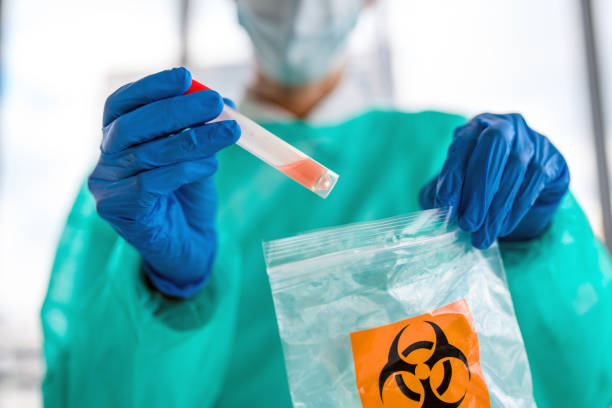
Any work with biological material can only be performed in a Class II laminar chamber (BSC). In addition, the transport of live biological material can only be carried out in closed containers. These containers can only be opened in a laboratory of at least BSL-3 class.
The laboratory requires regular cleaning and disinfection. It is important to adapt the surface for this purpose. It is not allowed to use carpets, etc. Any spaces in the floor, walls, or furniture must be sealed. Windows must not be opened and must be sealed. Ventilation should be designed so that the air flows from clean (uncontaminated) rooms to the BSL-3 laboratory. However, before leaving, the air is filtered.
The laboratory should have an eye wash station (eyewash) and touchless hand washing sinks located near the exit. Access to such a laboratory should be controlled at all times. A double set of self-closing doors should lead into the room. Access to the autoclave is required. It is recommended that it be located in the laboratory.
What is BSL-4?
Organisms included in this class are highly dangerous to human health and life. They are transmitted by the droplet route. Infections can be fatal and, moreover, in many cases we do not have drugs or vaccinations against these microorganisms. In this highest class, agents that have not yet been sufficiently characterized, and there is suspicion that they may be dangerous, for example, due to their affinity with those already classified, are also studied. Examples of agents included in BSL-4 are Ebola virus, or Marburg (hemorrhagic fever), as well as Lassa virus (Crimean-Congo hemorrhagic fever).In addition, in laboratories with the highest level of biosafety work with Hendra virus, Nipah virus and some flaviviruses. A special virus is Variola (which causes smallpox), which is studied in only two centers in the world in the US and Russia.
Working with organisms in this class requires special care and the observance of strict safety rules. Standard personal protective equipment is insufficient.
Two types of BSL-4 facilities
- Equipped with a laminar chamber with a protection class III. It is a type of chamber with an unopened, sealed window, into which materials are delivered through an airlock. The operator has access to its interior through sealed working areas with space for hands. Materials that leave the chamber must be disinfected. For this purpose, an autoclave or a tank with disinfectant is used as the exit airlock. The chambers must meet exacting standards. To facilitate cleaning, the edges of the chamber should be smooth. In addition, the risk of damaging gloves should be minimized. To this end, the chamber, as well as the materials inside it, should not have sharp edges.
- Equipped with vacuum suits. In such a laboratory, all work should be done in a Class II laminar chamber. It is necessary to use vacuum suits. A person should change clothes before entering the laboratory and put on a dedicated full-body protective suit with positive pressure and air supply. On leaving the lab, the worker must pass through a chemical shower for decontamination. In the next step, he passes through a room where he removes the positive-pressure suit. He then takes a personal shower in the next room.
The laboratory should be located in an isolated or enclosed area of the building. Access shall be controlled and limited to trained and authorized persons. Entry shall be through an airlock with airtight doors. A dedicated air supply and exhaust must be provided without recirculation. To avoid contamination and to facilitate cleaning, all surfaces such as walls, ceilings and floors should be an airtight interior shell. Decontaminate any laboratory waste including air, water, or trash before removal from the facility.
Summary
Laboratories are most often equipped to work with BSL-1 and BSL-2 material. BSL-3 and BSL-4 agents are tested in specially equipped research, diagnostic, clinical, or manufacturing facilities.
Biosafety levels allow the laboratory to adapt to the material being tested. Working with biological agents requires personnel to be very aware and knowledgeable. Without a doubt, he is responsible not only for his own health, but also for the health and safety of other people and the environment. It is therefore important to remember that even the best systems are no substitute for operator attentiveness.
Sources: