
The phrase “In my work, I do in vitro cell culture” often arouses an association in listeners with in vitro fertilization. However, is this the right clue? In vitro embryo culture, although the most well-known, is only the tip of the iceberg of applications of this technique.
What is in vitro?
“In vitro” in Latin means “in glass.” In vitro research, therefore, is nothing more than the transfer of reactions normally occurring in a living organism to laboratory conditions. This includes chemical reactions as well as the growth and differentiation of cells and tissues.
Why in vitro?
It can be said that the first experiments involving observation of frog nerve cells proved to be a real breakthrough. Although R. G. Harrison did not know how to keep the culture alive, he gave rise to the development of an amazing cognitive tool for science and medicine. By mirroring conditions in a living organism, processes that cannot be simulated on artificial models can be studied. In vitro cell and tissue cultures have furthermore made researchers largely independent of animal experimentation. This has made it possible to eliminate the ethical problem in many cases. Today it is difficult to overestimate the role of in vitro culture in the development of science, medicine, biotechnology. The use of cell and tissue cultures is widespread and also used on an industrial scale. Among other things, they are used to test the cytotoxicity of chemicals. With models that mimic intestinal villi, the permeability of the intestine to drugs and other compounds is studied. Cells in in vitro culture produce proteins such as insulin on an industrial scale. One can grow a piece of skin and use it for autologous transplantation. Applications abound.

Types of in vitro cultures
Primary culture is cells taken directly from the body by one of the available methods. According to the definition, up to 24 hours there can be no culture, but only a suspension of cells. After the first passage, the primary culture becomes a secondary culture. Most often, cells in primary culture attach to the surface to form a single layer.
In vitro culture in suspension can be carried out for cells that can grow and proliferate independently of attachment to the surface. This includes cell lines, cancer cells or blood cells.
Tissue and organ cultures allow the best replication of the situation in vivo. By culturing whole organs or parts of organs, the natural interactions between cells are preserved, allowing for highly reliable results.
Cultures on microcarriers provide the opportunity to grow a large number of adherent cells in a relatively small volume of medium. These are cultures conducted on beads made of various types of plastic (dextran, glass, gelatin, plastic).
Three-dimensional cultures are conducted to create models that mimic the tissues and organs of a living organism. These include organ cultures, aggregates and spheroids, organotypic cocultures, cultures on artificial capillaries, tissue and organ models.
Do cell and tissue cultures require special conditions?
Equipping an in vitro laboratory requires adequate knowledge and preparation. Cultures must take place under sterile conditions with very strict aseptic principles. Laboratory equipment and surfaces must be disinfected. In addition, culture vessels can only be opened in a laminar chamber. In vitro cultures are conducted under specific conditions of humidity, temperature and CO2 content. A culture medium with nutrients and mineral salts is used. This is done to make the culture conditions as similar as possible to those in a living organism. Should, despite strict aseptic rules, the culture become contaminated with microorganisms, a prophylactic addition of antibiotics to the medium is used.
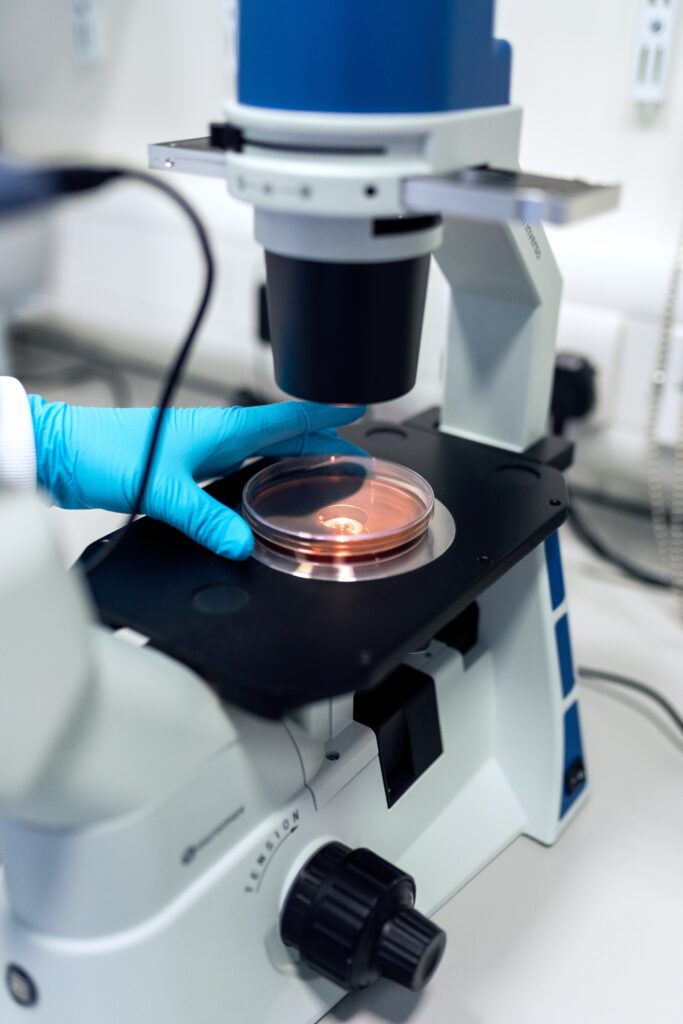
It is difficult to imagine today’s science and medicine without cell and tissue culture. Testing new drugs, cosmetics, dietary supplements, research on food allergens, production of therapeutic proteins are among the many applications. Methods related to in vitro culture are written into the standards of good laboratory practice, or manufacturing, among others. We can only wait for more spectacular discoveries involving them.
Sources:
- [i] Władysław Kopaliński: in vitro; in vivo. W: Słownik wyrazów obcych i zwrotów obcojęzycznych [on-line]. slownik-online.pl. [dostęp 2016-07-09]. [zarchiwizowane z tego adresu (2013-07-02)].
- Harrison R.G. 1907. Observation on the living, developing nerve fibre. Proc. Soc. Exp. Biol. Med. 4: 140- 143.
- Hodowla komórek i tkanek in vitro. P.red. Stanisławy Stokłosowej; 2004
Chcesz być na bieżąco? Zapisz się do naszego newslettera!